Check Alamo's median days on market in March 2026 and you'd think it was the hottest pocket in the East Bay: homes were going pending in 9 days. Check the same number in May, two months later, and it had ballooned to 81 days. Nothing about the town changed in between. What changed was the sample size.
That single fact tells you more about how to shop Danville against Alamo than any headline median will. If you've been comparing these two towns on a portal, you've probably noticed they look almost interchangeable on paper: same freeway exit off I-680, same school district, both regularly described as the East Bay's premier suburban addresses. But the price gap between them isn't a quality gap. It's a structural one, and it comes down to something buyers rarely think to check: who actually governs the town you're about to move into.
The number that's mostly noise
Start with the volatility, because it's the thing most likely to mislead a buyer scrolling listings late at night.
| Month (2026) | Alamo homes sold | Alamo days on market |
|---|---|---|
| March | 14 | 9 |
| April | 25 | 44 |
| May | 24 | 81 |
| July | not reported | 35 |
Fourteen sales in March. Twenty-five in April. Twenty-four in May. When a town closes fewer than thirty homes in a typical month, one estate sale that lingers for a slow buyer, or one well-priced listing that gets three competing offers in a weekend, can swing the median days-on-market figure by weeks. That's exactly what happened between April and May: a jump from 44 to 81 days that had nothing to do with buyer demand cooling and everything to do with which two dozen houses happened to close.
Danville doesn't have this problem, mostly because it doesn't have this problem's cause. The town moved 128 homes in June 2026 and 214 in July, roughly ten times Alamo's monthly pace, and its days-on-market figure held in a tighter band across the same stretch, 20 days as of the three months ending June, 27 days in July. More sales means outliers get absorbed into the average instead of dominating it.
If you're cross-shopping both towns, the takeaway isn't "Alamo is unpredictable and Danville is stable." It's that Alamo's monthly snapshot is close to useless on its own. A buyer or seller judging timing off a single month's Alamo figure is reading noise as signal. Anyone advising you to price or time an Alamo listing off last month's number alone is skipping a step.
What the premium is actually buying
Here's the part that doesn't show up in a median-price comparison at all: Danville is an incorporated town. Alamo is not.
Alamo has no city hall, no elected city council, no municipal government of its own. It's governed directly by Contra Costa County, and county land-use policy for the area is explicit about what it protects: minimal change to existing single-family neighborhoods, with any future density directed toward the small commercial node near the Iron Horse Trail rather than spread through residential streets. There is no Alamo downtown to redevelop because the governing policy doesn't point toward building one. The community's only real commercial presence is a shopping center near Stone Valley Road. For dinner, a farmers market, or a Saturday spent downtown, Alamo residents drive to Danville or Walnut Creek.
Danville took the opposite path, deliberately, over decades. It's an incorporated town with its own government, and that government has spent that time building and maintaining the civic core that Alamo buyers explicitly opt out of: the restaurant row on Hartz Avenue, the Village Theatre, a Saturday farmers market, a walkable downtown that draws visitors from across the region. That infrastructure isn't free. It's baked into the price of a Westside Danville home, where values run $2.5 million to $3 million or more, closing most of the gap with Alamo's citywide median even though the house itself might be smaller and sit on a tighter lot.
So when you look at Alamo's premium over Danville's citywide median, you're not looking at better construction or better finishes. You're looking at the cash value of land and privacy in a place where the governing body has made it structurally impossible to build more of either.
The schools aren't the differentiator you think they are
Both towns feed San Ramon Valley Unified for most addresses, including schools like Monte Vista and San Ramon Valley High for a large share of Danville. That's worth stating plainly because it means school access, which drives so much of the price conversation in other East Bay comparisons, isn't actually what separates these two towns. Exact assignment still depends on the specific address, so verify boundaries for any property you're seriously considering, but the broad pattern holds: you are not paying an Alamo premium for better schools. You're paying it for something else entirely.
What a bigger lot actually costs, and pays back
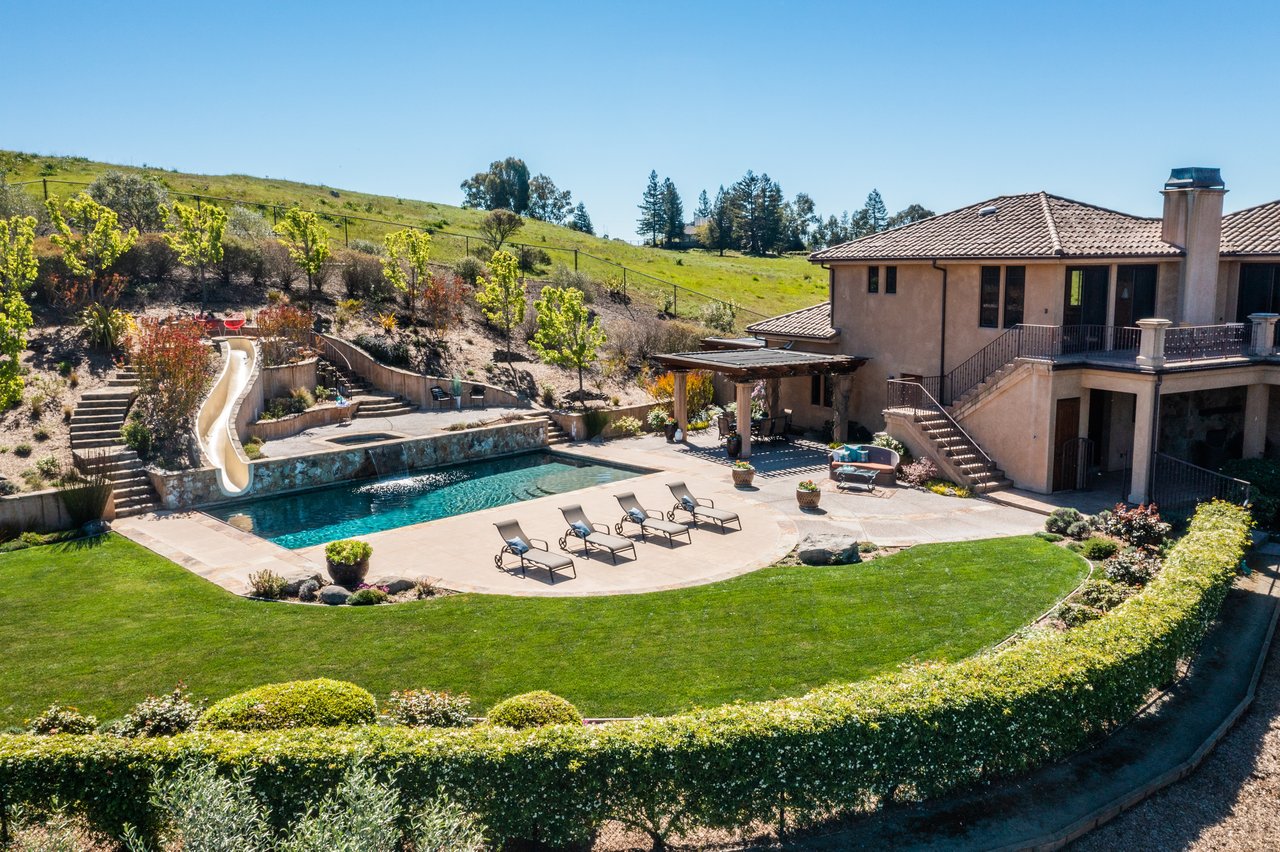
The lot-size gap is real and it's the clearest physical expression of the governance difference. Alamo lots commonly run 0.3 to 0.6 acre, with occasional parcels pushing past a full acre, in named pockets like Stone Valley, Alamo Oaks, and the area around Roundhill Country Club. Danville's Westside lots, by contrast, typically run 0.2 to 0.4 acre, the direct tradeoff for sitting close enough to walk to dinner. Buyers chasing even more land than either town offers tend to widen their search toward Blackhawk's gated golf communities east of Danville or the tiny unincorporated town of Diablo, both of which show up constantly in the same conversations as Alamo and Danville precisely because they're solving the same land-versus-walkability equation at a different scale.
What's changed in 2026 is that this extra land has started generating its own return. A growing number of Alamo owners are adding accessory dwelling units on their larger parcels, and those ADUs are producing $3,500 to $4,500 a month in rental income. That's not a lifestyle amenity, it's a yield. For a buyer weighing whether Alamo's premium is worth paying, that ADU income is one of the few ways to translate "more land" into a number you can put next to the mortgage payment.
What this actually means if you're deciding between them
Stop comparing citywide medians and start asking which specific thing you're buying.
If what you want is to walk to a restaurant on Hartz Avenue, catch a show at the Village Theatre, or run into neighbors at the Saturday farmers market without getting in a car, that's a Danville answer, and Westside Danville specifically is where you'll pay the closest thing to Alamo pricing for it.
If what you want is half an acre or more, real separation from the next house, and you're fine treating every errand as a short drive to Danville or Walnut Creek, that's what Alamo's premium buys, and buys reliably, because county policy has made sure the supply of that land stays capped.
And if you're timing an offer or a listing around a days-on-market figure you found on a portal, pull the trailing three to six months for Alamo specifically. A single month's number in a market that closes two dozen homes is not a market read. It's a coin flip that happened to land somewhere.
A few questions worth settling before you widen the search
Do Danville and Alamo really share the same schools? For most addresses in both towns, yes, both feed San Ramon Valley Unified. Specific school assignment is address-dependent, so confirm boundaries for any property before you factor schools into an offer.
Why does Alamo's days-on-market number swing so much more than Danville's? Volume. Alamo typically closes somewhere between 14 and 32 homes in a given month. Danville closes well over a hundred. A small handful of outlier sales moves Alamo's median far more than the same outliers would move Danville's.
Is there anywhere to walk to in Alamo at all? There's a small shopping center near Stone Valley Road. Beyond that, dining, retail, and community events mean a short drive to Danville or Walnut Creek. For many Alamo buyers, that's the point rather than the drawback.
If you're weighing Danville against Alamo, or trying to figure out what a specific property's price is really buying you once you factor in lot size, location, and how the numbers behave month to month, that's exactly the kind of comparison Lauren Kraus walks San Ramon Valley buyers and sellers through every week. Request your complimentary home valuation and get a read on where your specific property or target neighborhood actually sits, not just what the citywide median says.