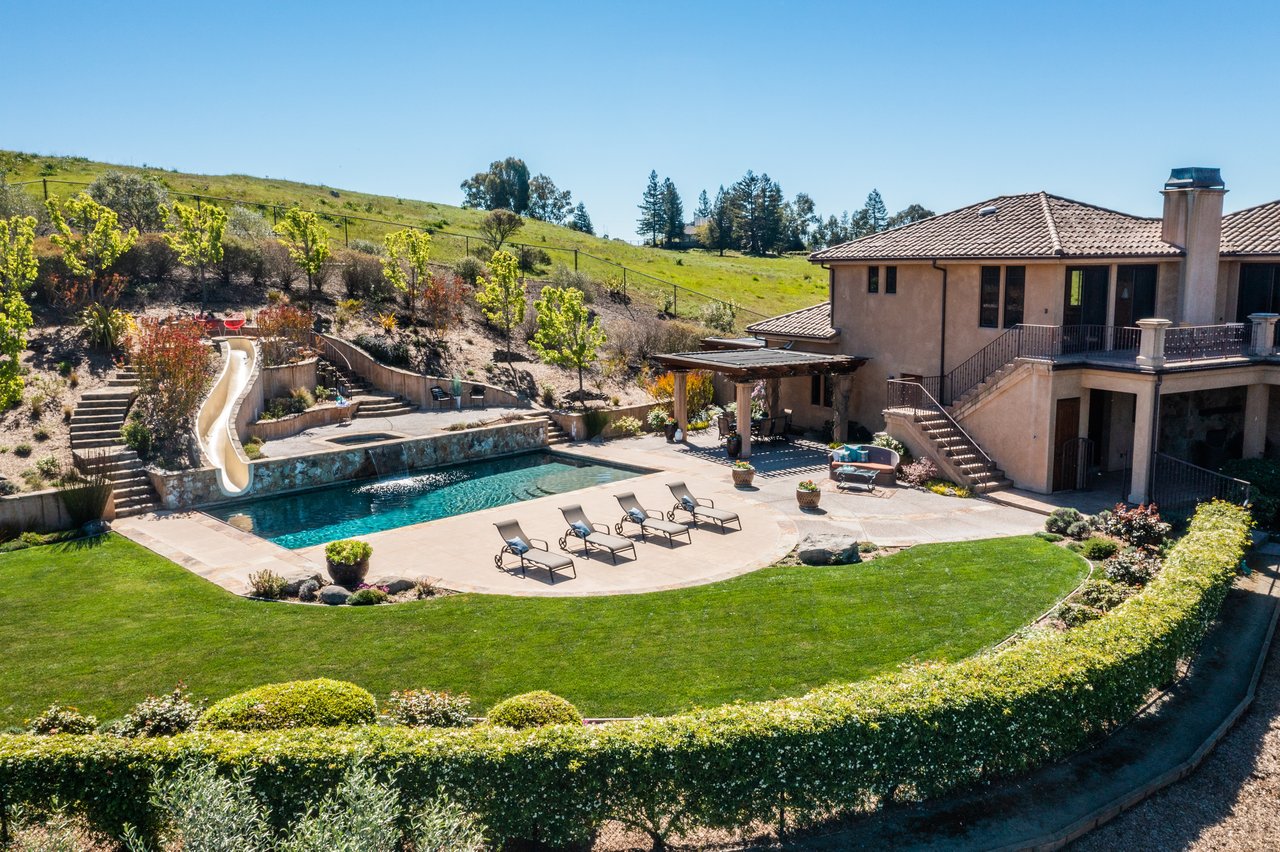
"Diablo still feels like a club, not a hotel. This is a place with soul." That's how Bruce Pruitt, the general manager of Diablo Country Club, described the clubhouse after four years of construction dust finally cleared. He said it in June 2024, at a reopening party that drew more than 700 members and guests. More than two years later, the line still captures something true about this small, gated community at the base of the mountain that shares its name: almost nothing that shapes daily life here comes from a town council, because there isn't one. It comes from a membership vote, or from a cycling club's event permit, or from whatever the state decided to do with a mountain the town happens to sit under.
This fall, both of those forces are pulling on the same small strip of land at once. On October 4, a bicycle race takes over the only paved road most residents use to leave their own neighborhood. And the clubhouse that reopened in 2024 is still the place where the town actually gathers, now with a rebuilt kitchen and a bar that didn't exist before.
One road, one Sunday, no detour
Diablo sits at the end of Diablo Road, which becomes Mount Diablo Scenic Boulevard as it climbs toward the state park's South Gate entrance. There's no second way out. That geography is background noise most of the year. On October 4, it becomes the whole story.
That Sunday is the 42nd Mount Diablo Challenge, an 11.2-mile timed climb up South Gate Road that gains 3,249 feet on the way to the summit. The event is run by the Valley Spokesmen Bicycle Club, which took over from the nonprofit Save Mount Diablo in 2017, and it's capped at 1,200 riders. Online registration closes September 29. Riders park at Monte Vista High School in Danville, pedal roughly 2.9 miles to the starting line at the Athenian School, and finish back at Monte Vista for an after-party with barbecue, awards, and music. Mount Diablo State Park's own alert for the day confirms the mechanics: vehicle access to North Gate, South Gate, and Summit Roads closes from 8 a.m. to 2 p.m. Macedo Ranch and Mitchell Canyon stay open as usual, and every trail and fire road in the park remains accessible on foot.
What's easy to miss in that description is the one instruction aimed specifically at the town: riders are told to stay on Diablo Road and Mount Diablo Scenic Boulevard both to and from the event, and not to cut through the Diablo community itself. It's a small line in a long set of event rules, but it says something real about the geography. The community's private streets sit close enough to the race route that a tired cyclist looking for a shortcut back down could easily end up inside a residential gate that was never meant to be part of the course. The organizers built the rule around the town, not the other way around.
Here's what that means for anyone living inside the gates that weekend:
| Time (Oct 4) | What's closed | What's open |
|---|---|---|
| 8 a.m. to 2 p.m. | North Gate, South Gate, and Summit Roads to vehicles | Macedo Ranch and Mitchell Canyon entrances, all trails and fire roads on foot |
None of this is decided in Diablo. It's decided by a bicycle club headquartered elsewhere, in partnership with the state park system, with proceeds flowing to Save Mount Diablo through a sponsorship from the Nathan M. Ohrbach Foundation. The town has no vote in it. It just has one road.
The room the town actually gathers in
The club at the center of Diablo's social life has its own version of that same dynamic: private, member-run, and still the thing everyone in town measures the season against.
Diablo Country Club was founded in 1914 by Robert Noble Burgess on land that had been an 1874 estate known as Railroad Ranch, once owned by a group that included Leland Stanford, Charles Crocker, Mark Hopkins, and Collis Huntington. Burgess built it around a phrase that still appears in the club's own materials: "A Community With an Ideal." The original golf course was designed by Jack Neville and William Watson, the same pair who designed Pebble Beach, and it's the only course the two of them ever built together. The club's own history also credits its cooperation with turning the mountain itself over to the state, which is how a private golf club ended up sitting at the foot of a public park.
That history matters now because the club rebuilt itself so recently. The full project ran to $41 million across two phases. The first, a $12 million golf course renovation, wrapped in 2020. The second and larger phase rebuilt the clubhouse, the fitness and tennis facilities, and the food and beverage operation, breaking ground in 2023 and reopening June 1, 2024.
What came out of it is now the town's actual gathering space. Red Horse, the club's main dining room since 1917, was rebuilt as the social hub it always claimed to be, paired with a new 21-and-older space called the Mt. Diablo Pub, which the club describes as unusual among East Bay clubs. There's a new Chef's Table for small private dinners, an expanded kitchen, a new Fitness Center overlooking the pool, and a renovated Tennis and Childcare Center with an updated pro shop bar and lounge. New Executive Chef Andy Arndt has pushed the kitchen toward farm-to-table sourcing from small local producers, and wine consultant Blake Pedersen has been filling the cellar with varietals members likely haven't seen anywhere else in the region.
None of that required a permit from a planning commission or a public hearing. It required a membership vote on a capital dues assessment. That's how change happens at the club, the same way an event permit and a nonprofit sponsorship are how change happens on the mountain road.
Two private calendars, one small town
Diablo is unincorporated. It has no city hall, no local elections, no planning department to petition. What it has instead is a mountain owned by the state and a clubhouse owned by its members, and this particular fall both of them are asserting themselves in ways that ripple through daily life whether or not a given household happens to belong to either institution.
For one Sunday, the road out of town belongs to 1,200 cyclists and a bicycle club's rulebook. For the rest of the season, the room where residents actually run into each other is the one that just came out of four years of construction, rebuilt by a vote most of the town wasn't part of. Neither of those things is a complaint. It's simply how a place this small and this specific ends up working: the calendar gets set by whoever holds the membership roster, not by whoever lives closest to the gate.
If you're curious how a market this particular actually moves, or what a property near the base of the mountain is worth given how much of daily life here runs on private calendars rather than public ones, Lauren Kraus tracks Diablo closely enough to have an answer that isn't generic.